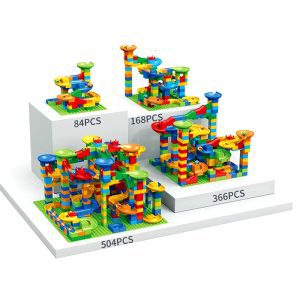
Standing in the toy aisle — or scrolling through fifty open tabs at 11 p.m. — with two construction toys in your cart and only one going home with you: this is one of the most common toy-buying dilemmas parents run into. Magnetic tiles have exploded in popularity over the last few years, but traditional building blocks aren't going anywhere either, and for good reason.
Here's the honest answer up front: it's not really magnetic tiles or building blocks. It's which one fits your child's age, personality, and the specific skills you're hoping to build right now. Below is a straight, research-backed comparison — including where each toy genuinely outperforms the other — so you can make a confident call instead of a guess.
The Quick Answer
If you only have thirty seconds:
- Choose magnetic tiles first if your child is 2–4, easily frustrated by things that fall apart, or you want a toy that delivers an instant, satisfying “click” with almost no learning curve.
- Choose traditional building blocks first if your child is 4+, enjoys precision and problem-solving, or you want a toy that rewards patience and planning over instant results.
- Choose both, staggered by age, if you're building a long-term toy collection — most families who own both end up reaching for magnetic tiles more in the toddler years and blocks more from preschool onward.
What Makes Magnetic Tiles Different
Magnetic tiles are flat geometric panels — squares, triangles, rectangles — with magnets sealed along each edge, so any two pieces snap together on contact. That single design choice changes everything about how a toddler experiences the toy.
The core advantage is near-zero frustration. A two-year-old can't yet manage the fine motor precision that stacking or interlocking requires, but they absolutely can press two magnetic edges together and feel them click. That instant success is what makes magnetic tiles such a strong entry point into construction play — the research on toddler magnetic building play consistently points to this as the reason toddlers return to tiles daily rather than abandoning them after one frustrating session.
Magnetic tiles also build in three dimensions almost by accident. Two triangles become a square; four squares standing on edge become a box; a flat panel laid on top becomes a roof. Kids don't need to understand geometry to discover it — they just need to keep clicking pieces together and watch shapes emerge.
The trade-off: magnetic tiles are less precise. You can't build a small, exact replica of something the way you can with uniform blocks, and structures tend to be bigger and looser rather than tightly engineered. For open-ended, low-frustration, sensory-rich play — especially at the toddler stage — that trade-off rarely matters.
What Makes Traditional Building Blocks Different
Blocks — whether classic wooden cubes, interlocking brick systems, or connector sets like our Snowflake Building Bricks — ask more of a child, and that's exactly where their value comes from.
Stacking a block on top of another without it toppling requires balance, spatial judgment, and a steady hand. Interlocking a connector piece requires understanding how two shapes fit together — often through a few failed attempts first. That friction is the point: blocks reward iteration. A child who tries, watches it fall, and tries again is building persistence and problem-solving alongside the physical structure.
Blocks also tend to support more precise, planned building. A child working toward a specific idea — “I'm building a garage exactly this wide so my truck fits” — will generally find blocks give them finer control than magnetic tiles do. This is part of why block play is so consistently studied by developmental researchers: the constraints of blocks force more deliberate spatial reasoning than the comparatively forgiving click-and-go nature of magnetic tiles.
The trade-off: blocks demand more fine motor maturity and more patience, which means younger toddlers can hit a wall of frustration faster. A block tower that collapses repeatedly can end a play session in tears for a two-year-old, while the same child will happily keep clicking magnetic tiles together indefinitely.
Head-to-Head Comparison
| Factor | Magnetic Tiles | Building Blocks |
|---|---|---|
| Best starting age | 2–3 | 3–4+ |
| Learning curve | Very low — instant success | Moderate — requires practice |
| Frustration risk | Low (structures rarely “fail”) | Higher (towers topple, pieces don't fit) |
| Precision / engineering value | Lower | Higher |
| Sensory feedback | High (magnetic “click,” see-through pieces) | Moderate (tactile stacking, weight) |
| 3D building | Very intuitive | Requires more planning |
| Mess & storage | Flat pieces stack neatly | Varies widely by set |
| Cost per hour of play | Low over time (durable, rarely discarded) | Low to moderate (depends on material) |
| Multi-age household fit | Good for mixed ages 2–8 | Best when most kids are 4+ |
| Screen-free, open-ended play | Yes | Yes |
What the Research Actually Says
It's worth separating marketing claims from actual developmental research here, because both toys have real evidence behind them — just for slightly different things.
The strongest research base belongs to traditional block play. A widely cited study from researchers at the University of Delaware and Temple University found that preschoolers who were better at reproducing block structures also scored higher on early math assessments — the first study to demonstrate that link in children this young, according to the Society for Research in Child Development. A separate large-scale study similarly found that children who frequently played with blocks, puzzles, and board games showed stronger spatial reasoning than children who didn't — a skill closely tied to later achievement in math and science, as reported by the Association for Psychological Science.
Magnetic tiles are newer to the market, so the research base is thinner, but the underlying mechanism is the same one developmental researchers already trust: open-ended, hands-on spatial construction play. Occupational therapists frequently recommend magnetic tiles specifically for fine motor and sensory-processing goals, and the safety and developmental research on magnetic tiles shows they're also widely used in speech and occupational therapy settings precisely because the instant, reliable feedback keeps children engaged long enough to build real skill.
The honest takeaway: blocks currently have more direct research tying them to measurable academic outcomes like early math. Magnetic tiles have a stronger case for engagement, independent play duration, and accessibility for younger or more easily frustrated builders. Neither cancels the other out — they're complementary, not competing, skill-builders.
Which One Should You Buy First?
If you can only buy one right now, match the toy to your child rather than to the trend.
Buy magnetic tiles first if:
- Your child is under 4
- They get frustrated easily and abandon toys that don't “work” right away
- You want something that holds attention independently so you can start dinner
- You're looking for a toy that scales with age with almost no ceiling — see our best magnetic tiles for toddlers guidefor specific set recommendations by age and play style
Buy building blocks first if:
- Your child is 4 or older and enjoys a challenge
- They already show interest in precision — lining things up, sorting by size
- You want to lean specifically into planning, patience, and fine motor development
- You're looking for something that pairs well with imaginative figures and vehicles for combined pretend-and-build play
Buy both, spaced out, if: Most families who end up with a full construction-toy shelf didn't buy everything at once. A common, low-regret pattern: magnetic tiles around age 2–3, blocks introduced around 3.5–4 once fine motor skills catch up, and both staying in regular rotation for years afterward since neither toy is truly “outgrown.”
Cost & Long-Term Value: A Closer Look
Sticker price alone is a poor way to compare these two categories, because the real cost comparison is cost-per-year of active play, not cost-per-box.
Magnetic tiles tend to win on longevity. Because the same core pieces work for a two-year-old stacking flat shapes and an eight-year-old building elaborate cities, a single starter set rarely gets “outgrown” the way many toddler toys do — it gets used differently as skills develop. A 60–65 piece starter set is typically enough for the 2–3 age range, and most families expand rather than replace, since quality tiles are cross-brand compatible. That expansion path means the second and third purchases add to the collection instead of duplicating it.
Building blocks vary more by type. Basic wooden block sets are inexpensive per piece and essentially indestructible, making them one of the best value-per-dollar toys in any playroom — but they offer less built-in variety, so older kids often need a second, more advanced set (gears, connectors, engineering-style pieces) to stay engaged. Connector-style block sets, like snap-together brick systems, sit in the middle: pricier per piece than basic wooden blocks, but capable of more advanced structures that hold interest longer into the school-age years.
The practical rule of thumb: if you're optimizing for the lowest cost per year of engaged play across ages 2–8, a mid-sized magnetic tile starter set that you expand over time is usually the stronger investment. If you're optimizing for durability and don't mind buying a second, more advanced set later, basic building blocks win on raw cost-per-piece.
For Siblings and Mixed-Age Households
If you're buying for more than one child at different ages, the calculus shifts again.
Magnetic tiles handle age spread unusually well. A 2-year-old and a 6-year-old can play with the exact same set of tiles side by side — the younger sibling makes flat, simple shapes while the older one builds enclosed 3D structures — without either child needing a “dumbed down” version of the toy. That's a genuine practical advantage for families who don't want to manage two entirely separate toy categories.
Building blocks handle age spread less gracefully unless you buy across a range: basic large blocks for a toddler, smaller and more advanced sets for an older sibling. The upside is that older children often naturally take on a mentoring role, building elaborate structures for a younger sibling to knock down and rebuild — a dynamic plenty of parents find genuinely valuable for sibling bonding, even if it isn't “quiet independent play.”
If keeping the toy shelf simple matters more than anything else, magnetic tiles are the easier single-category choice for a multi-age household. If you have the space and budget for two categories, pairing both gives each child a toy matched to their current stage.
Can You Use Both Together?
Yes — just not by snapping them into the same structure, since magnetic tiles and non-magnetic blocks don't physically interlock with each other. Where they combine beautifully is within the same play session: a block tower with a magnetic-tile roof, a block “road” leading into a magnetic-tile city, or blocks used as sturdy furniture inside a magnetic-tile house. Many parents also simply rotate which toy is out on a given day to keep both feeling fresh rather than becoming background clutter. For more structured combined-play prompts, our 10 magnetic tile building ideas includes several that adapt easily to mixed-material builds.
Common Buying Mistakes to Avoid
- Buying blocks too early and calling it a bad toy. A block set that frustrates a young 2-year-old isn't a bad toy — it's the wrong toy for that stage. The same set will likely click (sometimes literally) six months to a year later.
- Buying the biggest set “to save money later.” A 200-piece set dumped in front of a first-time builder is often more overwhelming than exciting. A smaller starter set that actually gets used beats a huge set that gets abandoned in the box.
- Assuming compatibility across every brand. Most standard magnetic tiles are cross-brand compatible, but connector-style blocks (like snap-together snowflake or interlocking brick systems) are usually only compatible within their own system — check before assuming two sets will combine.
- Ignoring your child's actual play style. A methodical, plan-first child will likely gravitate to blocks even at age 3; an instant-gratification builder may still prefer magnetic tiles at age 6. Watch what they reach for, not just what's marketed for their age.
Frequently Asked Questions
Are magnetic tiles better than building blocks for toddlers? For most toddlers under 4, yes — magnetic tiles have a lower frustration threshold and deliver faster, more satisfying results, which keeps very young children engaged longer. Building blocks tend to become the stronger choice from around age 4 onward.
Do magnetic tiles help with the same skills as building blocks? They overlap significantly — both build spatial reasoning, fine motor skills, and creativity — but blocks currently have a stronger direct research link to early math outcomes, while magnetic tiles have an edge in accessibility and independent play duration for younger children.
Can magnetic tiles and building blocks be used together? They won't physically snap together across most systems, but they combine well within the same play session — for example, a block base with a magnetic-tile roof, or both toys used side-by-side to build a larger imaginative world.
Which is a better first construction toy for a 2-year-old? Magnetic tiles are generally the better starting point at this age, since the low-frustration, instant-connection design matches a toddler's developing (but still limited) fine motor control.
Are wooden blocks better than plastic magnetic tiles? Neither material is inherently “better” — wooden blocks tend to be heavier and offer different tactile feedback, while magnetic tiles offer translucency, color, and the sensory click of magnets. The right choice depends on your child's sensory preferences and your household's noise and mess tolerance more than the material itself.
The Bottom Line
Magnetic tiles and building blocks aren't rivals — they develop overlapping but genuinely different skills, and the “right” one depends far more on your child's age and temperament than on which toy is trending. If your child is younger, easily frustrated, or new to construction play, start with magnetic tiles. If they're a bit older and drawn to precision and problem-solving, blocks will likely hold their attention longer.
Not sure which set fits your child best? Browse the full KidsBaron Magnetic Tiles collection — sorted by age and piece count — or check out the Snowflake Building Bricks if your child is ready for a more precision-driven build.